

Menu

TL;DR
- AI security platforms (AISPs) protect how you use and build AI by inspecting prompts, responses, data flows and agent actions.
- Firewalls and endpoint tools can’t see inside a model’s behavior, so attackers can “talk” an AI into leaking data or acting out of bounds.
- IBM’s 2025 breach report found 13% of organizations had an AI-related breach, and 97% of those lacked AI access controls.
- Shadow AI (unapproved tools) was linked to 1 in 5 breaches and added about $670K to breach costs.
- The main threats are prompt injection, data leakage, model poisoning, supply chain attacks, system prompt leakage and over-permissioned agents.
- Gartner frames AISPs around two pillars: AI Usage Control (third-party AI) and AI Application Security (AI you build).
- Choosing one comes down to shadow AI discovery, agent controls, stack fit, speed, audit-ready logs and an honest roadmap.
- The rollout is five steps: inventory, classify data, set policy, test, monitor.
- No tool stops prompt injection completely, so layer guardrails, least-privilege access and regular testing.
Most businesses locked down their networks, endpoints and cloud years ago. Then they plugged in AI, and the risk moved somewhere their old tools can’t see.
Your firewall can’t tell when a chatbot is tricked into leaking customer data. Your antivirus won’t notice a poisoned model. That gap is exactly what AI security platforms exist to close.
In this guide, we’ll explain what they are, what they protect, and how to pick the right approach without the jargon.
What Is an AI Security Platform?
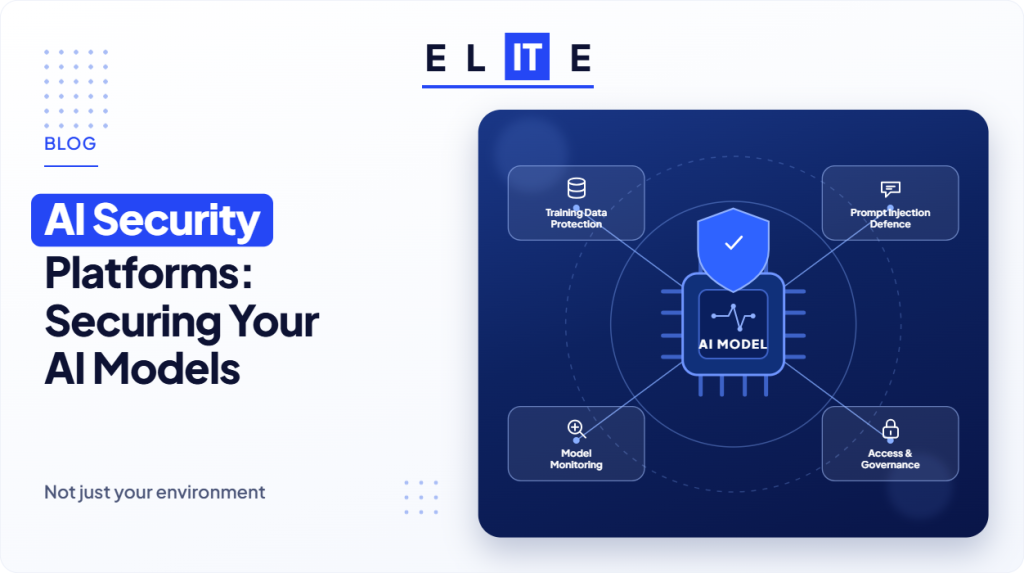
An AI security platform (AISP) is a single layer of controls that protects how your organization uses AI and how you build AI. It watches prompts, model responses, data flows and AI agent actions, then enforces your rules in real time.
Think of it as a firewall, policy engine and security camera built specifically for AI.
| 📊 Fact Box Gartner named AI security platforms a top strategic technology trend for 2026. It also predicts that more than half of enterprises will use one by 2028, up from under 10% today. |
Why Environment Security Alone Isn’t Enough
Traditional security protects the container: networks, devices, servers. AI risk lives inside the model’s behavior. Here’s the difference:
| Question | Traditional Security | AI Security Platform |
| What does it inspect? | Network traffic, files, logins | Prompts, outputs, agent actions |
| What can it catch? | Malware, unauthorized access | Prompt injection, data leakage, rogue agents |
| Who is the “user”? | Humans and devices | Humans, models and autonomous agents |
| What does it audit? | Access logs | Every AI interaction and decision |
An attacker doesn’t need to break in. They can simply talk your AI into doing the wrong thing. Want to see how AI can spot attacks before they land? Read our guide on Preemptive Cybersecurity, How AI Predicts & Stops Attacks.
| 💡 Did You Know? In 2025, a flaw called EchoLeak (CVE-2025-32711) showed a zero-click attack on Microsoft 365 Copilot. One crafted email was enough to pull out internal file contents, with no user clicking anything. |
The Numbers Behind the Risk
IBM’s 2025 Cost of a Data Breach Report was the first to dig into AI security. The findings are sobering:
- 13% of organizations reported a breach involving their own AI models or applications.
- 97% of those organizations lacked proper AI access controls.
- 1 in 5 breaches involved “shadow AI,” meaning unapproved tools used by employees.
- Shadow AI added about $670,000 to the average breach cost.
- Teams using AI and automation across their defenses saved roughly $1.9 million per breach.
The lesson is clear. AI adoption is racing ahead of AI governance. In plain terms, most teams are switching AI on first and asking security questions later. A platform flips that order by giving you visibility, rules and an audit trail before something goes wrong, not after the damage is done.
6 AI Threats a Good Platform Should Stop
OWASP’s Top 10 for LLM Applications is the industry’s go-to checklist. These are the threats you’ll hear about most:
- Prompt injection: Hidden instructions in prompts, emails, files or web pages that hijack the model. It’s ranked #1 on the OWASP list.
- Sensitive data leakage: Models revealing customer records, credentials or intellectual property.
- Data and model poisoning: Tampered training data, fine-tuning sets or embeddings that quietly change model behavior.
- Supply chain attacks: Compromised open-source models, datasets or libraries.
- System prompt leakage: Attackers extracting your hidden instructions. OWASP added this in 2025.
- Excessive agent permissions: An AI agent with broad access turns one bad answer into a real action, like deleting records or sending data out.
The Two Pillars of an AI Security Platform
Gartner frames AISPs around two jobs. Most platforms cover both, though some lean one way. If you’re building your own models, the second pillar matters most, and it helps to work with a team offering proven AI Solutions from the design stage.
| Pillar | What It Protects | Key Capabilities |
| AI Usage Control | How employees and systems use third-party AI (ChatGPT, copilots, APIs) | Shadow AI discovery, policy enforcement, data masking, usage monitoring |
| AI Application Security | AI you build and deploy yourself | Model scanning, AI red teaming, runtime guardrails, agent monitoring, kill switches |
Underneath both sits continuous logging. Every prompt, response and policy decision is recorded, which makes audits and incident investigations far easier.
How an AI Security Platform Works in Practice
You don’t need to understand every component, but the basic flow is simple:
- An AI gateway sits between your users or apps and the AI model.
- Every request is inspected for sensitive data, injection patterns and policy violations.
- A policy engine decides in milliseconds: allow, block, redact or escalate.
- The response is checked before it reaches the user.
- Everything is logged for compliance and forensics.
The same logic applies to AI agents. Each tool call is checked against what that agent is allowed to do, just like a human employee with limited permissions.
What the Market Looks Like
The AI security space is crowded and moving fast. Vendors tend to come at the problem from different angles:
| Approach | Focus | Best When |
| AI-native runtime security (e.g., Palo Alto Networks Prisma AIRS, Check Point’s Lakera-based guardrails) | Model scanning, red teaming, prompt protection | You build custom AI apps |
| Extended endpoint and SOC platforms (e.g., CrowdStrike, SentinelOne) | AI visibility tied to existing detection | You already run these platforms |
| Zero Trust and identity (e.g., Zscaler, Okta) | Who or what can reach which data and tools | Agents are touching sensitive systems |
| Observability and recovery (e.g., Dynatrace, Rubrik) | Tracing agent activity and rolling back damage | Autonomous actions carry high risk |
Maturity varies a lot. Some agent-security features are still in preview or early access, so always ask vendors what is generally available today versus on the roadmap.
| 💡 Did You Know?
Only about a third of organizations have formal policies to detect or manage shadow AI, according to IBM’s 2025 findings. Most companies simply don’t know which AI tools their teams are using. |
How to Choose the Right Platform: A Practical Checklist
Skip the feature-list contest. Ask these questions instead:
- Does it find all your AI? Shadow AI discovery should come first.
- Does it cover both pillars? Third-party usage and your own models.
- Can it control agents? Look for per-tool permissions and least privilege.
- Does it plug into your stack? Identity, SIEM, cloud and data classification.
- Is it fast? Security checks that slow AI down get bypassed.
- Are the logs audit-ready? Regulators increasingly expect proof of AI controls, as we explain in how AI governance is reshaping compliance audits.
- Is the roadmap honest? Separate shipped features from promises.
A 5-Step Rollout Plan
- Inventory: List every AI tool, model, API and agent in use, approved or not.
- Classify data: Decide what must never reach an AI system.
- Set policy: Define who can use which AI for what purpose.
- Test: Run red-team exercises and penetration testing against your AI apps before attackers do.
- Monitor: Review logs weekly and tune policies as threats change.
Final Thoughts: Secure the AI, Not Just the Environment
AI is now part of how your business thinks, decides and acts. Protecting the network around it is necessary, but it’s no longer sufficient. The model, the data it touches and the agents acting on its behalf all need their own security layer.
That’s where the Elite IT Team comes in. Our AI team builds custom AI, machine learning and generative AI applications with security designed in from day one, not bolted on later. Our cybersecurity specialists then back that up with managed security services, vulnerability management, compliance support and 24/7 monitoring.
You get one partner who understands both sides: how AI is built and how it’s attacked.
Ready to see where your AI stands? Book a free consultation with Elite IT Team and let’s build AI you can trust.
Frequently Asked Questions
What is the difference between AI security and traditional cybersecurity?
Traditional cybersecurity protects networks, devices and applications. AI security protects the model's behaviour: what it's asked, what it answers and what actions it takes. Both are needed, because AI systems still run on regular infrastructure.
Do small and mid-sized businesses need an AI security platform?
Not always a full platform, but they do need the basics. If your team uses AI tools with customer or company data, you need usage policies, access controls and monitoring. Start small, then scale as AI use grows.
What is shadow AI, and why is it dangerous?
Shadow AI means employees using unapproved AI tools without IT's knowledge. It's risky because sensitive data can leave your organization unnoticed. IBM linked it to one in five breaches in 2025.
Can an AI security platform stop prompt injection completely?
No tool offers a 100% guarantee. Platforms reduce the risk through input filtering, output checks, least-privilege access and monitoring. The strongest defence is layered: guardrails plus tight permissions plus regular testing.
Popular Post
Get our stories delivered From
us to your inbox weekly.
Get a response tomorrow if you submit by 9pm today. If we received
after 9pm will get a reponse the following day.
Subcribe to our Newsletter
Subscribe for Updates: Stay informed about the latest investor updates, financial
results, and announcements by subscribing to our newsletter.
results, and announcements by subscribing to our newsletter.