

Remember when compliance audits meant a once-a-year scramble where everyone panicked, organised shared drives, and handed auditors a massive stack of PDFs?
Ah, sweet nostalgia.
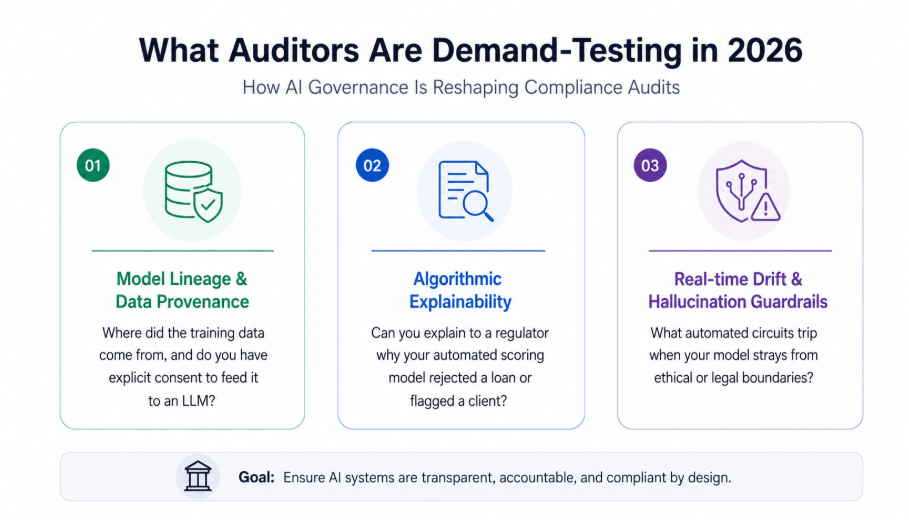
Welcome to 2026, where compliance auditors aren’t just looking at your financial spreadsheets or ISO 27001 policies anymore. They want direct access to your AI systems. They’re scrutinising your LLM training pipelines, demanding real-time model drift logs, and probing whether your customer service bot just accidentally leaked GDPR-protected data to a prompt engineer in Munich.
Whether your organisation is building AI systems, integrating third-party AI tools, or simply using consumer AI platforms internally, AI governance is now at the top of your auditor’s checklist.
Let’s break down what’s changing, why traditional audits fail when faced with shadow AI, and how forward-thinking UK businesses are turning strict compliance into a real competitive advantage.
Table of Contents
- Why Traditional Compliance Audits Are Struggling With AI
- The AI Governance Regulations Businesses Need to Understand in 2026
- Compliance Audits Are Becoming Continuous, Not Annual
- The shadow AI blindspot that keeps CISOs up at night
- Why SMEs Cannot Ignore AI Governance and Compliance
- How Businesses Can Build AI Governance Into Their Operations
Why Traditional Compliance Audits Are Struggling With AI
For decades, compliance was reactive. You sampled 5% of your records once every 12 months, proved you had password rules, and earned your shiny certificate.
As highlighted in recent global insights from KPMG on evolving compliance functions, the manual approach is long dead. Modern AI systems learn, adapt, ingest fresh data, and output thousands of automated decisions every hour.
A static annual audit tells you if your AI was compliant six months ago. It tells you nothing about whether its outputs are biased, unaligned, or non-compliant right now.
The AI Governance Regulations Businesses Need to Understand in 2026
Underneath the cultural shift sits a genuinely complicated regulatory picture, and it rewards precision rather than vague good intentions.
The EU AI Act’s high-risk obligations take effect on 2 August 2026: conformity assessments, registration, documented risk management, logging and human oversight, backed by fines of up to €35 million or 7% of global turnover. UK businesses are not automatically outside this. Any organisation whose systems touch EU customers or EU data is potentially in scope, regardless of where its head office sits.
The UK, characteristically, has not produced a single AI law to sit alongside it. Instead there is a set of overlapping regimes, each with its own logic and its own timetable.
| Framework | What it covers | Where it stands in 2026 |
|---|---|---|
| UK GDPR & Data (Use and Access) Act | Automated decision-making and profiling | In force, with new provisions on meaningful human review |
| ICO AI Code of Practice | Transparency and oversight in AI-driven decisions | Consultation complete; final code expected this summer, carrying real weight in enforcement |
| FCA and PRA expectations | AI use across financial services | Existing rules applied to AI rather than new ones written specifically for it |
| EU AI Act | High-risk AI systems, wherever EU customers or data are involved | High-risk obligations begin 2 August 2026 |
The Financial Conduct Authority has been explicit that it isn’t building a parallel AI rulebook. It is applying what already exists and expecting firms to demonstrate they have genuinely thought it through, not simply bolted an AI disclaimer onto an existing policy. That approach sounds pragmatic on paper. In practice, it means a firm can be technically compliant with three different frameworks and still fail the fourth, because none of them define “high risk” quite the same way.
Compliance Audits Are Becoming Continuous, Not Annual
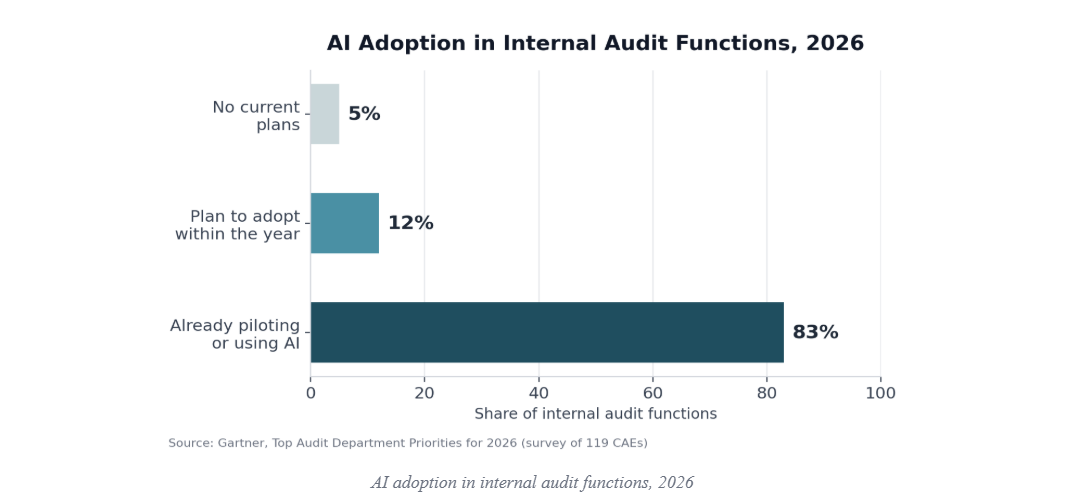
If compliance is being reorganised, the audit is being rebuilt outright. Gartner’s most recent survey of chief audit executives found that 83% of audit functions are already piloting or actively using AI, with a further 12% planning to within the year. That is close to the entire profession moving in the same direction at once.
The shift is not simply “AI does the audit now.” It is a change in what an audit even is. The traditional model, pull a sample, test it, extrapolate, and hope it was representative, is being displaced by something closer to continuous assurance: systems that review entire populations of transactions on an ongoing basis and surface exceptions as they occur, rather than months later when the sample finally gets pulled. Auditors spend less time hunting for problems and more time judging the ones a system has already flagged. It is a materially different skill set, and most functions are only partway through building it.
This is where Richard Seiersen, chief risk officer at Qualys, offers a useful corrective to the enthusiasm. He is candid that using AI for compliance will keep expanding through 2026, but pushes back on the assumption that historical data alone will meaningfully improve how organisations manage future risk. Much of what enterprises actually face, he argues, involves genuine, irreducible uncertainty that past patterns don’t predict well. His point isn’t a rejection of automation. It’s a reminder that expert judgement and structured forecasting don’t disappear just because a dashboard looks confident. Organisations serious about this need to map their AI initiatives against the actual value at risk, rather than assuming better tooling automatically means better foresight.
The shadow AI blindspot that keeps CISOs up at night
Gartner estimates that by the end of 2026, 50% of enterprise security breaches related to AI will originate from unmanaged “Shadow AI” as in employees pasting sensitive corporate code, customer data, or internal strategy docs into third-party, consumer-grade AI tools.
You might think your AI stack is safe because you haven’t built a custom neural network. But if your marketing department is using unvetted web plugins and your dev team is feeding source code into external LLM endpoints, you are failing your compliance audit before it even begins.
Why SMEs Cannot Ignore AI Governance and Compliance
It would be easy to read all of this as a large-enterprise problem, the kind of thing FTSE boards and their in-house counsel worry about. It isn’t. Mid-sized firms and fast-growing SMEs are exposed in exactly the same ways, often more so, because they are less likely to have anyone watching this space full-time, and every framework above applies regardless of headcount.
This is the environment we work in daily at Elite IT Team, sitting across managed IT, cybersecurity, compliance and custom AI builds, which means we tend to see the operational side of these predictions before they show up in a board pack. A client wants AI to solve a genuine operational problem, and in the same conversation asks whether it creates a compliance one. The honest answer is usually that it does, unless the groundwork is built in from the outset rather than retrofitted once something goes wrong: logging built into the integrations themselves, one named person accountable for AI risk rather than a quarterly committee, and infrastructure capable of producing an audit trail the moment someone actually asks for one.
How Businesses Can Build AI Governance Into Their Operations
We help businesses map where AI already sits across their operations (there is almost always at least one system nobody remembered to document), test that against the frameworks that genuinely apply to them, and put the technical and documentation groundwork in place to prove compliance when it counts, whether that’s an EU AI Act conformity assessment, an ICO enquiry, or simply a client asking how you know their data is being handled properly.
If you’re not sure whether any of this applies to your business yet, that uncertainty is usually the answer in itself. The organisations that get caught out over the next year are unlikely to be the ones who avoided AI. They’ll be the ones who adopted it quickly and never went back to check what it was actually doing.
Get in touch with Elite IT Team for an AI governance and compliance readiness conversation. We’ll tell you plainly where you stand, what’s genuinely urgent, and what can reasonably wait.
